
Finance Minister Nirmala Sitharaman is likely to strike a fine balance between being fiscally prudent and growth supportive when she presents her fourth straight budget on Tuesday, which is expected to have plans to boost spending to revive investment and create jobs. The Budget for the fiscal year starting April 1, 2022 is likely to raise spending on infrastructure to set the economy on a firmer footing. The stage for the Budget presentation was set by the Economic Survey stating that the government has the fiscal space to do more to support the economy that is forecast to grow at a healthy 8-8.5 per cent growth in the 2022-23 fiscal.

The government on Monday projected a 16.67 per cent growth in gross tax revenue in the next fiscal beginning April 1, at over Rs 22.17 lakh crore. The revised estimates of gross tax revenue for the current fiscal has been pegged at Rs 19 lakh crore, lower than the Rs 24.23 lakh crore budgeted earlier. Economic Affairs secretary Tarun Bajaj said, "Our revenue figure is under-stated not overstated.
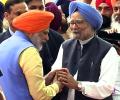
Whether it was the MGNREGS or the NFSA or the Aadhaar-based DBT scheme for cash transfer, the Modi government has built on the basic architecture created by the Singh government. Policy makers in the Modi government, instead of discarding them as products of the previous political regime, worked on them, expanded their scope and reach, and used new tools to improve their performance, explains A K Bhattacharya.

'But can it afford to present a scenario within the existing legal framework of fiscal consolidation?', asks A K Bhattacharya.

Can the finance minister manage our expectations, asks A K Bhattacharya.

'Personal income tax is growing by 27 per cent and most refunds have already been issued.'

The 1.4% decline projected for 2025 is driven by a 5.6% (72,000) dip in the strength of railway employees to 1.2 million by next year.

The Centre is likely to cut budgetary support to the railways by around Rs 5,000-10,000 crore for 2018-19, out of the total budgeted GBS of Rs 53,060 crore. Due to this cut in GBS, the railways is likely to depend more on borrowings, asset monetisation, and internal generation to meet the capex target of Rs 1.465 trillion for the current year.

The government had breached its fiscal deficit target given in the Budget for 2017-18 in November itself, touching 112 per cent of the limit.

Against FY17 target of Rs 56,500 cr, Centre plans to fetch around Rs 6,400 cr in the first half.
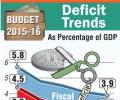
Finance Minister Arun Jaitley presented the Budget today.

Widening of the tax base, doing away with cess and surcharge, improvement in compliance and moderation in tax for emerging sectors are some of the suggestions submitted to the Finance Ministry ahead of the Budget by Think Change Forum (TCF). Experts are of the opinion that there is a need to grow tax revenues for the government to drive economic growth and make investments in developmental activities, TCF, the think tank said in a statement. Towards this end, poor compliance was identified as a weak link in achieving targeted collections leading to complex issues like overtaxing, complicated tax structures, rising litigation, among others.

A Rs 559.91 crore (Rs 56 billion) deficit budget (2003-04) that proposes to generate Rs 170 crore (Rs 1.7 billion) additional resources through taxes was presented on Monday by Madhya Pradesh Finance Minister Ajay Narayan Mushran in the Assembly.
The auction of third generation (3G) spectrum is expected to close in one-two days, with the government likely to rake in Rs 50,000 crore from it.

The government wants new domestic companies to set up their manufacturing units fast and hence the concessional tax rate of 15 per cent has been extended by a year till March 2024, revenue secretary Tarun Bajaj said on Friday. Stating that direct and indirect tax collections are going up and have good buoyancy, Bajaj said it means that the corporate sector is also doing well, and India's tax to GDP ratio could be "highest ever" in the current year. The Budget 2022-23 presented on February 1 has proposed that the concessional 15 per cent corporate tax rate would be available for one more year till March 2024 for newly incorporated manufacturing units.

There appears to be a growing perception among the political class that faster growth will not create jobs fast enough and, therefore, welfare spending needs to be drastically increased, says T T Ram Mohan.

After the Covid-19 pandemic that derailed the economy since 2019, the Durga Puja festival in West Bengal is back with an estimated 20-30 per cent jump in festive spending. Retail sector is the key contributor to the state's Durga Puja economy which was Rs 32,377 crore in 2019, according to a British Council study conducted for the state government. Retail accounts for 85 per cent of the total puja economy and the rest is shared among pandal making, decoration, illumination, entertainment, advertisement, food & beverage and others.

The coaching-tuition-profiteering model built on the back of a broken education system is a scandal and an abomination, and must go, asserts Shekhar Gupta.

This amount will include Rs 13,100 crore that Economic Affairs Secretary Subhash Garg has been publicly seeking from the central bank's contingency reserve fund since 2017-18 (FY18).

Rural outlay may go up 23% to reduce pains of demonetisation
In absolute terms, revenue receipts stood at Rs 9.07 lakh crore at the end of October. For the entire 2019-20, the revenue receipts have been pegged at Rs 19.62 lakh crore.

Exporters on Thursday demanded fiscal incentives, tweaking in customs duties on certain products and credit at affordable rates in the forthcoming Budget to boost exports and create jobs. In a pre-budget virtual meeting with Finance Minister Nirmala Sitharaman, the Federation of Indian Export Organisations (FIEO) said the depreciation of the rupee against the US dollar is affecting exports' competitiveness and the sector requires more support. "Creation of employment is the biggest challenge faced by the country...We would urge the government to provide fiscal support to units which provide additional employment in the export sector," the exporter's body said.
Softening the demonetisation blow, the Budget for 2017-18 on Wednesday halved the tax to 5 per cent on incomes up to Rs 500,000 but proposed a new surcharge of 10 per cent on incomes between Rs 50 lakh and Rs 1 crore and raised duties on cigarettes and pan masala while stepping up allocations for infrastructure, rural, agriculture and social sectors.

Given the gap between budgetary allocation and use, a parliamentary standing committee has asked the Ministry of Ayurveda, Yoga and Naturopathy, Unani, Siddha and Homeopathy (Ayush) to take steps to prevent underutilisation of funds under the National Ayush Mission (NAM) scheme. According to the data, the ministry was allocated Rs 1,200 crore for the mission in the Budgetary Estimate (BE) for FY24. The Revised Estimate (RE) for the year fell to Rs 815 crore, of which Rs 589 crore, or 74 per cent, has been spent till January.

'The vision now is not just to look at national highways as a number of kilometres, but quality as well.'

'Even before the outbreak of the flu, it had become clear that the tax revenue numbers for 2019-2020 were overestimated,' observes A K Bhattacharya.

If the government cuts wasteful expenditure as it is trying now, the deficit would at most fall to 8 per cent, not less than that.

Petrol price can go down to Rs 75 a litre across the country if brought under the ambit of the Goods and Services Tax (GST), but there is a lack of political will, which is keeping Indian oil product prices at one of the highest in the world, economists at SBI said on Thursday.

Gross collection of tax on corporate and individual earnings jumped nearly 24 per cent so far in the current fiscal year that started on April 1, the tax department said on Sunday. The gross collection of taxes on corporate earnings rose 16.74 per cent during April 1 to October 8, while personal income tax collection jumped 32.30 per cent, the tax department said in a statement. Direct tax collection came at Rs 8.98 lakh crore between April 1 to October 8, 2022, 23.8 per cent higher than the gross collection in the corresponding period a year ago.

Trade estimates pegged the Hindi version collection at Rs 210 million -- a commendable performance for a dubbed film.

Country's fiscal deficit touched Rs 516,390 crore or 95.2 per cent of the annual target during April-December, the Controller General of Accounts said.

Govt may further hike excise on petrol, diesel before Budget.

It is possible that the final Budget architecture may be at variance with the comments.

Populism gains momentum during election periods, and this trend is evident in at least four states: Telangana, Rajasthan, Madhya Pradesh and Chhattisgarh.

The capital outlay for the three services, for modernisation, stood at Rs 78,586.68 crore

'Nirmalaji's Budget announcements have long-term implications and are not backed by enough money when the short-term outlook looks bleak,' notes T N C Rajagopalan.

Per capita income in the state has consistently been below the national average for at least 24 years. However, it has narrowed the gap with the all-India level in recent years.

The challenge of achieving fiscal deficit targets for the next two years seems daunting.
During April-October 20 period, the tax department has made refunds to the tune of Rs 80,850 crore.
 © 2026 Rediff.com - Advertise with us - Disclaimer - Privacy Policy - Sitemap - Feedback - About us - Terms of use - Grievances